

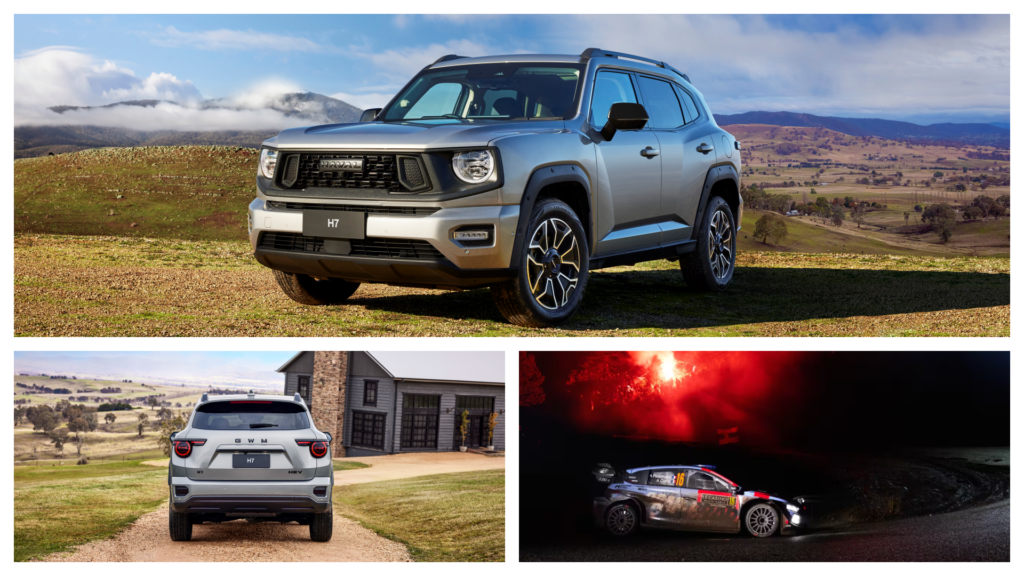
In this episode of Overdrive David Brown and Paul Murrell examine how artificial intelligence and new mobility technologies are reshaping pedestrian safety, urban transport and the relationship between people and cars. They discuss real-world trials, innovations from CES 2026, cultural and regulatory trade-offs in infrastructure, recognitions in the transport sector, shifts in driver training and a road test of the GWM Haval H7 Hybrid.
Artificial Intelligence Improving Pedestrian Safety
David and Paul open with a look at AI beginning to reshape everyday road infrastructure. A prominent example is the Securus soffit system trialled in Dublin, Ohio, which uses sensors and adaptive lighting to detect pedestrians approaching a crossing and illuminates the area to alert drivers. When no one is present the lights dim, reducing light pollution and saving energy.
Beyond the immediate safety benefits, the hosts note that such systems gather movement data that helps planners understand how people use roads and crossings. They point out similar sensor approaches used in coastal New South Wales to detect when fishermen are swept from rocks, illustrating how monitoring technology can support safety across different environments without relying solely on changes to driver behaviour.
Mobility Innovation at CES 2026
At CES 2026 mobility solutions featured more prominently than in some recent years, with a clear emphasis on accessibility and connected transport modes. Highlights included AI-assisted wheelchairs, advanced e-bike systems and digital platforms designed to better link public transport with private mobility options, all aimed at improving first-mile and last-mile connections.
David and Paul welcome the focus on inclusivity but caution that technology alone cannot fix poorly designed transport systems. Without coordination among planners, engineers and policymakers even promising innovations risk becoming isolated pieces rather than integrated elements of a coherent mobility network.
Engineering, Regulation and Cultural Perspectives
The hosts reflect on an idea from Dan Wang’s book Breakneck: China’s rapid infrastructure development is partly driven by an engineering-dominated culture, while the United States is shaped more by legal and regulatory concerns. They acknowledge that robust regulation can slow projects but argue that purely technocratic decision-making can overlook social consequences.
Using examples of controversial Chinese policies, David and Paul suggest that effective transport development needs a balance between engineering ambition and thoughtful governance to avoid efficiency-driven outcomes that harm communities or cultural values.
Recognising Contributions to Transport and Heritage
Overdrive pauses to recognise people who have influenced transport and community life. The late Brian Willoughby is remembered for his role in preserving Rouse Hill House in Sydney’s west by shaping road planning decisions in the 1990s, showing how committed individuals inside government can protect cultural heritage through infrastructure choices.
They also highlight Rob McInerney’s appointment as an Officer of the Order of Australia for his leadership in the International Road Assessment Programme (iRAP). iRAP’s data-driven approach helps governments prioritise road safety investments and reduce trauma through better infrastructure design worldwide.
Driving Skills and the Changing Culture of Motoring
David and Paul reminisce about older cars and rally experiences, noting how earlier vehicles demanded more active driver involvement: poor lighting, heavy steering and limited braking required skill and constant attention. These memories lead into a critique of modern driver training, which they say often lacks practical, scenario-based learning.
While modern driver-assistance systems improve safety, the hosts argue that awareness, judgement and hands-on experience remain vital. Skills such as handling a skid, recovering from a dropped wheel off the road and emergency braking are rarely taught in depth but are still important for real-world driving safety.
Road Test: GWM Haval H7 Hybrid
The episode closes with a road test of the GWM Haval H7 Hybrid, a mid-size SUV priced at around $47,000 drive-away. Positioned as a more premium alternative to the Haval H6, the H7 offers a refined interior, improved styling and hybrid efficiency, though its rugged looks belie the fact that it is front-wheel drive only.
David and Paul find the H7 comfortable, well equipped and competitively priced. Thoughtful climate controls, a practical layout and a smooth hybrid drivetrain contribute to a positive overall impression, and the vehicle is another example of how improving quality and competitive pricing are helping Chinese manufacturers expand their presence in Australia.