

Episode Breakdown
- Electric vehicle sales and changing buyer preferences – 00:01:50
- Cost-of-living pressures and choosing smaller cars – 00:12:10
- Fog, driver behaviour and road safety – 00:17:11
- Autonomous buses and London’s new black cab – 00:24:00
- Targa Tasmania, feedback and unusual car materials – 00:38:34
- Connected trucks: turning data into decisions – 00:45:06
- Road test: GWM Cannon Alpha Vanta diesel – 00:52:49
Short Summary
Electric vehicle sales are growing, but which models are attracting buyers, and are smaller cars making a comeback?
David Brown and Paul Murrell examine changing sales patterns and the influence of cost-of-living pressures.
They explore new research into fog and road safety, the importance of human assistance on autonomous buses, and the next generation of London’s black cabs.
There’s discussion of Targa Tasmania, innovative materials made from pineapple leaves, and the challenge of turning connected truck data into practical decisions.
Finally, they road test the GWM Cannon Alpha Vanta, examining how far Chinese utes have progressed in comfort, performance and refinement.
Fuller Summary
Electric Vehicle Sales: Growth and Changing Preferences
Australia’s electric vehicle market has expanded dramatically during 2026, although monthly sales reveal an uneven pattern. June was the strongest month, followed by a decline through September and October.
David Brown and Paul Murrell examine the market by manufacturer, corporate group and vehicle category. BYD leads corporate groups with approximately 25% of electric vehicle sales, followed by Tesla with 23%. The Tesla Model Y remains the leading individual model, but BYD benefits from a much broader product range.
Medium SUVs dominate, accounting for 56% of EV sales, while large electric SUVs and dual-cab utes remain relatively minor categories.
An interesting development is the improvement in the rankings of smaller electric vehicles, including the Geely EX2 and MG4 Urban. Mazda’s electric models are also gaining ground.
The discussion considers supply constraints, the BYD Atto 1’s promotional pricing, and whether electric vehicles might help revive demand for traditional hatchbacks and sedans.
Cost-of-Living Pressures: Are We Buying Too Much Car?
Research discussed by Paul Murrell suggests Australians are increasingly questioning whether they need the size, expense and capabilities of the vehicles they purchase.
One finding suggests many people buy larger vehicles to accommodate activities they undertake only occasionally. Paul recalls advising someone who wanted a Toyota LandCruiser primarily to tow a boat just two or three times a year. His suggestion was to purchase a more economical everyday vehicle and hire something larger when necessary.
He then admits that he once bought a V8 Holden Monaro for similarly occasional towing duties.
David raises the possibility of vehicle subscription or swapping arrangements that allow motorists to choose different vehicles according to their immediate requirements.
The discussion also questions whether increasingly elaborate technology delivers genuine benefits. Modern vehicles can offer an extraordinary range of features, but how many are actually used?
The underlying issue is whether buyers should pay for capabilities they rarely need.
Fog and Road Safety: When Visibility Disappears
New Australian research examining weather patterns between 1980 and 2024 indicates that fog is becoming more frequent along parts of the southern coastline while declining in some northern regions.
David and Paul consider the implications for road safety, particularly the danger of sudden visibility reductions on high-speed roads.
Paul recalls driving through extremely dense fog on a French motorway while other motorists continued travelling at speeds approaching 150 km/h. He also describes a rally incident in which two cars following each other disappeared off the road.
David discusses international crash research suggesting that fog-related crashes can involve more vehicles and produce more serious consequences.
The conversation considers the limitations of adaptive cruise control in poor visibility and the importance of forgiving road design.
The F6 motorway between Sydney and Wollongong provides an example of improved road standards and fog-warning systems.
The central message is that fog creates hazards, but driver behaviour and road design substantially influence the consequences.
Autonomous Buses and London’s Next Black Cab
A self-driving bus may be capable of navigating safely, but who helps passengers when something goes wrong?
Research from Cambridge’s Connector project involving 48 participants with access needs highlights the importance of information, reassurance and human assistance throughout a journey.
David and Paul discuss the wider implications of removing drivers and conductors from public transport, including passenger security, accessibility and the social value of human interaction.
They also revisit Western Australia’s RAC Intellibus trial, which provided thousands of passenger journeys while revealing some of the practical limitations of autonomous operation.
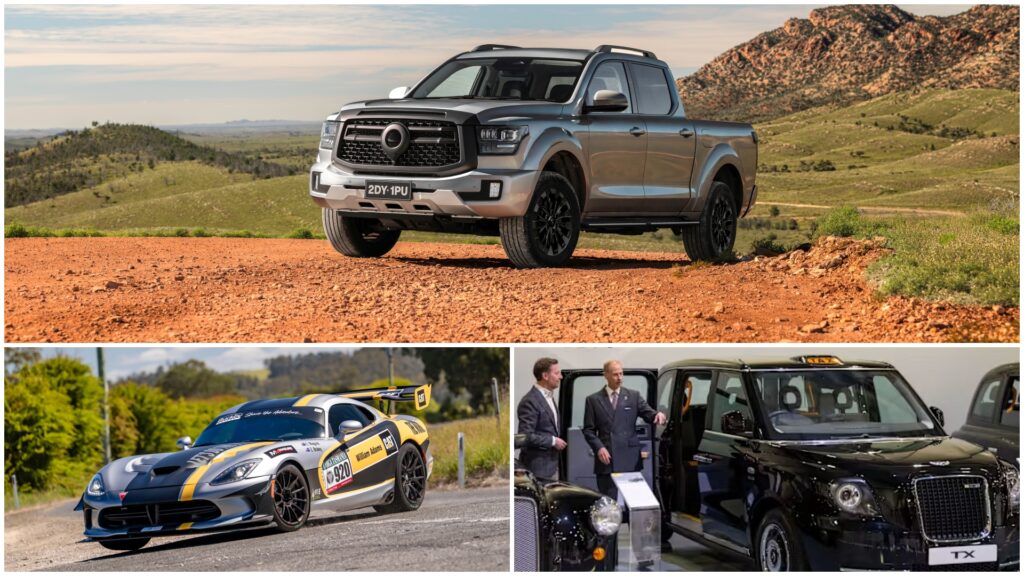
The conversation then turns to London’s next-generation black cab, being developed by the Geely-owned London Electric Vehicle Company.
The new vehicle, expected in 2027, will retain the distinctive character of the traditional London taxi while incorporating contemporary design and technology.
David and Paul discuss the famous Knowledge test, manoeuvrability, passenger needs and the role of British automotive tradition in a Chinese-owned company.
Targa Tasmania, Pineapple Panels and Automotive Marketing
The program returns to Targa Tasmania and the remarkable variety of vehicles participating in the event.
Among the more unusual entries is an Austin A30, a modest British small car competing in an event associated with considerably more powerful machinery.
The discussion reflects the appeal of historic vehicles and the enthusiasm of competitors who continue to enjoy older automotive technology.
Attention then turns to Nissan’s collaboration with Japan’s Food Reborn company to develop exterior automotive panels using plastic reinforced with pineapple leaf fibres.
David and Paul consider whether such innovations offer practical environmental benefits or primarily create marketing opportunities.
The discussion broadens to other unconventional materials, including silk, and the potential for natural fibres to find new applications in automotive manufacturing.
There is also some gentle scepticism about the language manufacturers use to promote technological developments.
The challenge is distinguishing genuinely useful innovation from an attractive publicity story, particularly when the commercial benefits are still being established.
Connected Trucks: Data Is Only Useful When It Leads to Action
Modern commercial vehicles can generate enormous amounts of information about location, fuel consumption, maintenance requirements and driver behaviour.
Yet David Brown argues that collecting information is only the beginning. Fleet operators need systems that convert data into useful decisions.
A truck may be delayed by congestion or an incident, but customers should not have to telephone the operator to discover what has happened.
Connected systems could provide more accurate arrival estimates, identify disruptions and recommend alternative routes.
Paul recalls a frightening incident involving unsecured material falling from a truck, leading to a discussion about monitoring driving behaviour and improving operational safety.
The conversation also examines harsh braking, acceleration, driver conduct and the opportunities for better fleet management.
David raises the importance of cooperation between vehicle manufacturers, transport operators and government agencies.
Sharing appropriate information could improve the management of public roads, provided commercial confidentiality and data security are protected.
Road Test: GWM Cannon Alpha Vanta 3.0-Litre Diesel
The final segment examines the GWM Cannon Alpha Vanta, a large dual-cab ute powered by a 3.0-litre turbo-diesel engine.
David and Paul reflect on how far Great Wall Motors has progressed since its earlier Steed utility, particularly in comfort, refinement and overall presentation.
The Cannon Alpha demonstrates the increasingly sophisticated nature of Chinese vehicles entering the Australian market.
Its large cabin, substantial dimensions and practical features prompt discussion about what ute buyers actually need.
The conversation examines the rear tailgate arrangement, the small opening window between the cabin and tray, and the vehicle’s distinctive styling.
Particular attention is given to the diesel engine and nine-speed automatic transmission.
Paul suggests that a larger engine operating under less strain can sometimes deliver better fuel economy than a smaller engine working harder.
The discussion also considers gear selection, torque delivery, engine noise and the remarkable improvements in diesel refinement over recent years.
Credits
David Brown: Presenter, news, analysis and road testing.
Paul Murrell: Co-presenter and motoring commentator, SeniorDriver.au.
Evan Jones: Acknowledged for assistance with the program.