

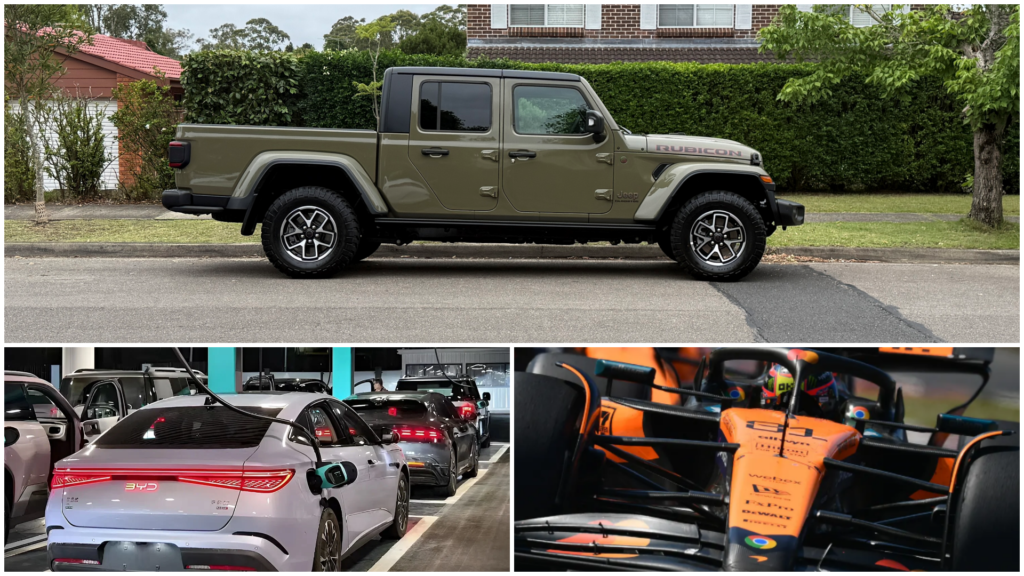
In this episode David Brown and Paul Murrell cover the opening of the 2026 Formula One season, the growing workload on drivers, cars in film and culture, faster EV charging, a tiny classic that fetched a huge price, concerns about distracted driving, and a practical road test of the Jeep Wrangler Rubicon.
F1 season opens with Mercedes
George Russell led Kimi Antonelli home for a Mercedes one-two at the Australian Grand Prix, ahead of Charles Leclerc and Lewis Hamilton. The result sparks a wider conversation about how modern F1 cars load drivers with information, controls and constant feedback. The hosts reflect on Oscar Piastri’s formation-lap crash and note that even the most advanced cars can catch drivers out, touching on downforce, mirrors, cameras and the old racing art of finding an edge within the rules.
Driver overload and visibility
Murrell highlights the sheer volume of information elite drivers process at speed, while Brown questions whether more screens and warnings always help. The discussion moves to road cars, considering camera mirrors, rearward vision and driver aids: these systems can support safety but also add potential distraction. Managing visibility and information is one of the episode’s strongest themes.
Cars in film and culture
A Hispano Suiza appearing in a Barcelona-set streaming drama prompts a detour into product placement and screen fame. The hosts compare movie cars that became icons with others that gained fame without commercial success, citing the DeLorean, Mad Max Falcon, Monaro, Mini and references like Kingswood Country. Their broader point is that cars once carried more cultural aspiration than they do for many younger people today.
EV charging moves faster
Polestar’s updated 3 brings quicker charging, more computing power and stronger specs, but the hosts wonder whether the market is already moving beyond it. Public charging access remains as important as headline recharge times. That leads into BYD’s latest ultra-fast charging claims: Murrell sees the technology as a potential answer to range anxiety, while Brown notes how rapidly EV development is shortening product relevance.
Tiny classic, huge price
Murrell highlights the surprising sale of a Peel P50 for an extraordinary sum, raising the familiar question of what makes a classic valuable. Rarity, novelty and collector appeal clearly matter more than practicality; the hosts enjoy the absurdity of a tiny car with no reverse gear and almost no mass, and what that says about classic-car culture.
Are drivers losing focus?
This feature segment examines whether digital life is eroding attention spans and weakening driving standards. Murrell links phone use, GPS dependence and a constant information flow to poorer focus and spatial awareness, while Brown expands the discussion to include sleep, stress, work pressure and the design of in-car warnings. Their conclusion: better driving increasingly depends on managing distraction as much as on vehicle handling.
Jeep Wrangler Rubicon tested
The Wrangler Rubicon is presented as a serious off-roader that has grown larger, pricier and more civilised, but still carries compromises. Brown finds it more usable in daily driving than expected, though wind and tyre noise remain noticeable. Murrell agrees it is still a niche purchase with genuine off-road credibility and a loyal following willing to forgive its rough edges; it remains an adventure machine first and a commuter second.